
 Blogs
Views: 0 Author: Site Editor Publish Time: 2026-09-19 Origin: Site


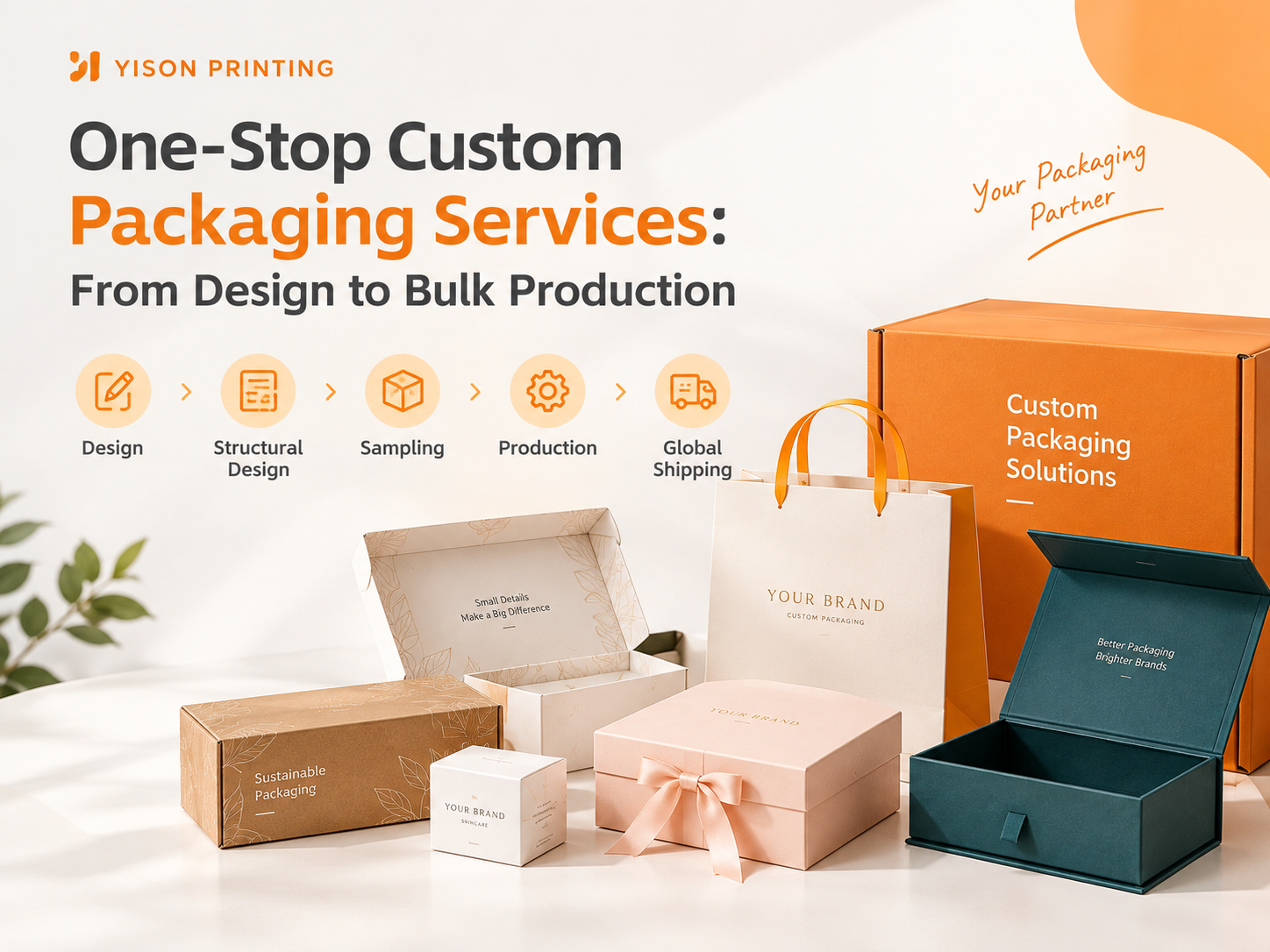
A packaging project rarely starts with a finished box. It often begins with a product, a rough idea, a reference image, or simply a packaging requirement. Turning that starting point into thousands of finished boxes requires more than just printing a logo on paper.
The process may involve product analysis, structural development, artwork preparation, material selection, prototyping, sampling, bulk manufacturing, quality control, packing, and shipping. When these stages are connected through one workflow, brands can manage the entire packaging project more efficiently.
This is where one-stop custom packaging services can play an important role. Instead of coordinating separate suppliers for design, production, inspection, and delivery, brands can work with one packaging partner throughout the entire project.
For businesses with bulk or recurring packaging needs, an integrated workflow can simplify the transition from the initial packaging concept to consistent large-scale production.
Before choosing a box structure, a packaging project needs to start with the product itself.
The size, weight, shape, handling requirements, sales channel, and shipping environment can all influence the final packaging structure.
For example:
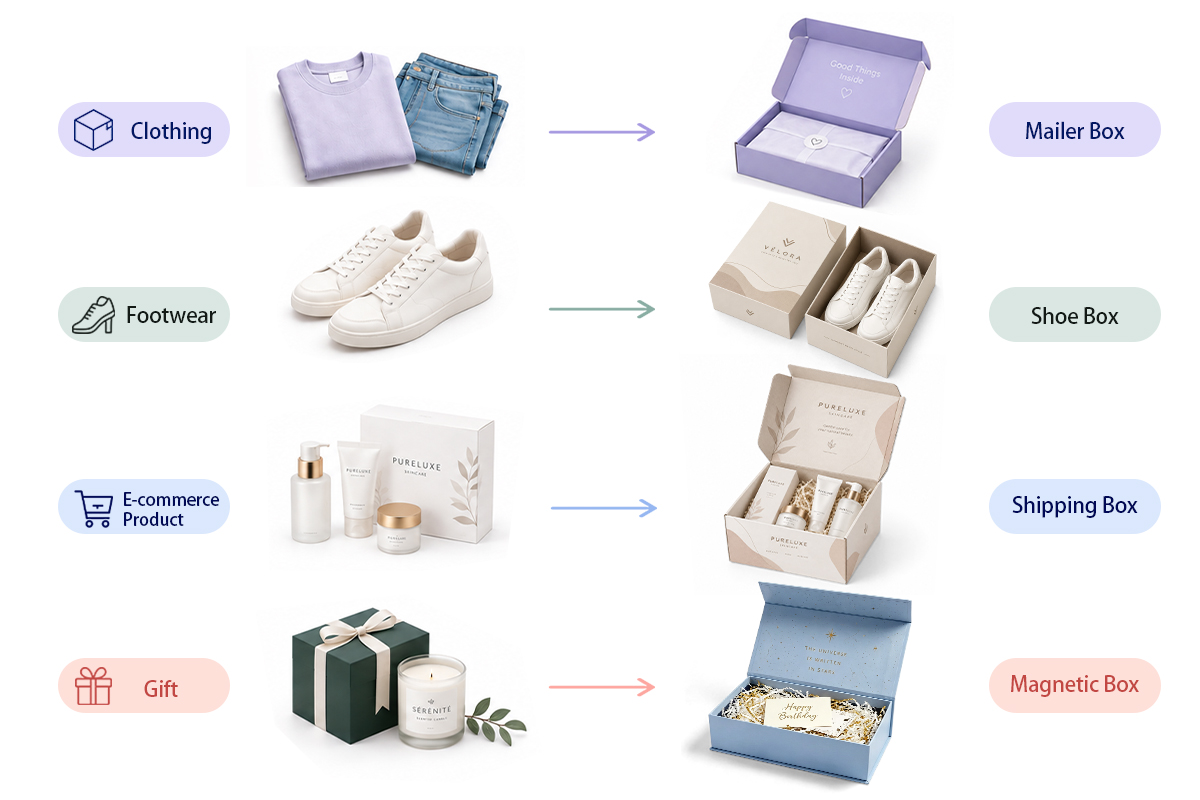
Apparel products may require apparel boxes, folding cartons, or mailer packaging.
Footwear commonly uses shoe boxes that need appropriate dimensions and stacking strength.
E-commerce products may require mailer boxes or shipping boxes that can withstand transportation.
️Retail products may need packaging that combines product protection with shelf presentation.
Gift products may require rigid boxes, drawer boxes, or other presentation-focused structures.
The packaging should therefore be developed around the product and its distribution environment rather than starting with a predetermined box style.
For example, an online clothing brand might need different packaging than a footwear retailer that supplies physical stores. Even when both products use paper packaging, their structural and logistical requirements can be completely different.
The first step is not “Which box should we make?” It is “What does the product and its sales journey require?”
Once the product requirements are clear, the next step is to determine the packaging structure.
Different structures solve different packaging challenges.
Folding cartons are commonly used when brands need lightweight retail packaging that can be efficiently stored and displayed.
Mailer boxes are suitable for e-commerce and direct-to-consumer packaging, especially when the packaging needs to be shipped directly to customers.
Shipping boxes place greater emphasis on transportation and product protection.
Rigid boxes can provide a more substantial structure and are commonly used for gift, apparel, jewelry, electronics, and other product packaging applications.
Drawer boxes and magnetic closure boxes can create a distinctive opening experience while allowing brands to customize the structure around the product.
The structure can also include:
Custom dimensions
Internal inserts
Compartments
Windows
Ribbons
Magnetic closures
Tear strips
Special opening mechanisms
The objective is not simply to create a box that looks attractive. The structure needs to work with the product, filling method, storage requirements, transportation method, and customer experience.
A finished packaging product may look simple, but its development often begins with a two-dimensional structure.
A typical development process can include:
Dieline → 3D Visualization → Structural Prototype → Physical Sample
The dieline defines the dimensions, folding lines, cutting areas, glue areas, and structural layout of the packaging.
A 3D mockup helps visualize how the packaging may look after printing and assembly.
A prototype allows the structure to be tested before adding the final printing and finishing.
The physical sample provides a more realistic evaluation of size, material, opening method, product fit, and appearance.
This stage is especially useful for packaging with custom dimensions, inserts, unusual shapes, magnetic closures, ribbons, or multi-part structures.
A packaging project can therefore be developed progressively rather than moving directly from an idea to mass production.
Once the structure is established, the packaging needs to be translated into its final visual and tactile form.
Three elements usually work together:
Depending on the structure and application, packaging may use:
Art paper
Coated paper
Kraft paper
Folding carton board
Corrugated board
Rigid greyboard
Material selection can influence the box's stiffness, appearance, surface texture, printing performance, and overall presentation.
Common printing options include:
CMYK
Pantone
Offset printing
Digital printing
Brands with specific corporate colors should consider Pantone matching for colour consistency.
Finishing can further change the visual and tactile experience of packaging.
Options may include:
Matte lamination
Gloss lamination
Foil stamping
Embossing
Debossing
Spot UV
Textured paper
Varnishing
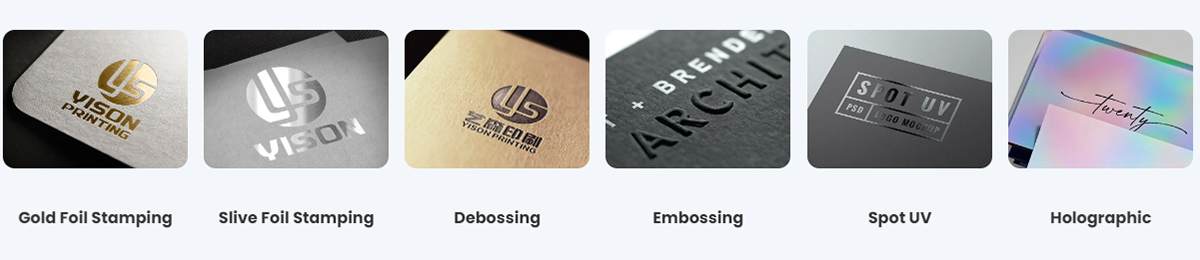
Instead of treating these options separately, a packaging project needs to consider how material + printing + finishing work together.
For example, textured paper may emphasize a tactile surface, while foil stamping can highlight selected brand elements. Spot UV can create contrast between glossy and matte areas.
The final combination should support the packaging's intended appearance and application rather than simply adding as many finishing effects as possible.
A packaging sample is more than a preview of the finished product. It is an opportunity to test whether the packaging actually works.
A design may look correct on screen but reveal unexpected issues during physical sampling.
For example:
The product may move inside the box.
The lid may fit too tightly.
An insert may not align correctly.
The opening method may be inconvenient.
A folding line may need adjustment.
The selected material may not provide the expected structure.
Finishing details may appear differently on the physical surface.
This is why the sampling stage can be used to verify:
Structure + Size + Material + Printing + Finishing + Product Fit
For custom packaging projects, physical testing can help identify issues before the specifications are transferred to bulk production.
The goal of sampling is not necessarily to create a perfect final product immediately. It is to create a reliable reference for the next stage.
Moving from one approved sample to bulk production is a major transition.
Mass production is not simply making the same sample thousands of times. It requires the approved specifications to be translated into a repeatable manufacturing process.
Depending on the packaging structure, the production workflow may include:
Printing → Die Cutting → Folding → Gluing → Surface Finishing → Assembly → Inspection → Packing
Each stage needs to work according to the approved specifications.
For larger orders, production planning also becomes important. Materials need to be prepared, production schedules need to be coordinated, and different manufacturing stages need to remain connected.
This is particularly relevant for brands ordering packaging in bulk or managing recurring packaging programs.
A sample proves that the packaging can be made.
Bulk production proves that it can be made consistently at scale.
Once packaging enters mass production, consistency becomes increasingly important.
The goal is to produce the right amount and ensure the finished products match the approved specifications.
Depending on the packaging type, production checks may focus on:
Dimensions
Printing quality
Color consistency
Folding accuracy
Surface finishing
Insert positioning
Closure alignment
Assembly quality
Quantity
For example, if a rigid box uses a magnetic closure, the alignment of the lid and base needs to remain consistent throughout production. If a mailer box uses a tear strip, the structure and opening function need to be checked as part of the finished product.
Quality control therefore needs to be considered as part of the production workflow rather than as something that happens only after all boxes have been manufactured.
For bulk packaging orders, this method helps match the approved sample with the final product more closely.
The packaging journey does not necessarily end when production is completed.
Finished boxes still need to be prepared for storage, transportation, and delivery.
A typical post-production workflow may include:
Finished Packaging → Inner Packing → Master Cartons → Palletizing → Container Loading → Shipping
Depending on the project, packaging may need:
Individual wrapping
Inner protection
Master carton packing
Carton labeling
Palletizing
Shipping marks
Export preparation
For international orders, the shipping arrangement may also involve different trade terms and transportation methods depending on the destination and order requirements.
An integrated packaging workflow can be helpful here. It allows production, packing, and shipping needs to be seen as one project instead of separate steps.
After following the complete packaging journey, the value of a one-stop approach becomes clearer.
It is not simply about having more services.
The main advantage is that different stages of a packaging project can be connected through one workflow.
Packaging requirements, design, sampling, manufacturing, QC, packing, and shipping can be coordinated as part of the same project.
Information from one stage can be carried into the next stage, reducing unnecessary repetition.
Instead of separately coordinating design, printing, production, inspection, and logistics providers, the buyer can work primarily with one packaging partner.
The approved packaging specifications can be used as the reference throughout the production process.
For brands with recurring packaging needs, established specifications can make future orders, new SKUs, and packaging updates easier to coordinate.
The value of one-stop packaging is therefore less about the number of services offered and more about how effectively those services work together.
A one-stop packaging workflow can support different packaging requirements across industries.
E-commerce brands may need packaging that combines product presentation with shipping functionality.
Typical options include:
Mailer Boxes, Shipping Boxes, Product Boxes, and Custom Inserts.
Yison's current product range includes mailing/corrugated packaging, including mailer box options for e-commerce applications.
Apparel brands may require:
Apparel Boxes
Folding Cartons
Mailer Boxes
Paper Bags
Hang Tags
The packaging can be developed around garment size, folding method, retail presentation, and shipping requirements.
Yison currently has a dedicated Clothing Packaging category covering apparel packaging and mailer packaging.
Footwear packaging needs to accommodate different shoe sizes and shapes while also considering stacking, storage, and transportation.
Custom shoe box structures can therefore be developed around the specific footwear product.
Yison offers shoe box packaging in both standard and customized structures.
Retail and consumer product companies may use:
Folding Cartons
Rigid Boxes
Display Packaging
Mailer Boxes
Product Packaging
The appropriate combination depends on where the packaging will be displayed, shipped, opened, and stored.
A one-stop packaging workflow can be illustrated through a typical project process at Yison Printing.
The process can move through several connected stages:
The project begins with product information, packaging dimensions, quantity, structure, materials, and intended application.
The packaging structure is developed around the product and required opening or shipping method.
Printing artwork and brand elements are prepared according to the approved packaging structure.
The structure, dimensions, materials, printing, and finishing can be reviewed before bulk production.
Once the specifications are confirmed, the project moves into mass manufacturing.
Production and finished packaging are inspected to help maintain consistency with the approved specifications.
Finished packaging is prepared for shipment according to the project's delivery requirements.
Yison's website describes its services as covering design, production, and logistics, while its product range includes gift boxes, corrugated boxes, paper bags, packaging boxes, clothing packaging, and shoe boxes.
Yison offers buyers a strong choice for a long-term packaging partner. They have over 15 years of experience in packaging manufacturing. Their production facility spans more than 13,000 m² and includes over 10 production lines. Plus, they can produce up to 500,000 boxes each month. From One Packaging Project to a Long-Term Packaging Program
For many brands, packaging is not a one-time project.
A product launch may begin with one packaging structure, but future requirements can expand into:
Repeat Orders → New SKUs → Seasonal Packaging → New Markets → Larger Production Volumes
For example, an apparel brand may initially need packaging for one product line and later introduce additional sizes, collections, or seasonal packaging.
An e-commerce company may begin with one mailer box and eventually require several box sizes for different product categories.
This is where a scalable packaging workflow becomes increasingly useful.
A packaging partner who knows the product specs, materials, structure, artwork, and production needs can help with future projects. They won’t see each new order as starting from scratch.
For brands with recurring packaging requirements, the long-term value of a packaging supplier therefore goes beyond a single production order.
A successful packaging project is more than producing a box.
It is a connected process that moves from:
Product → Structure → Prototype → Sample → Production → QC → Packing → Delivery
A one-stop custom packaging service brings these stages together, allowing brands to manage their packaging projects through a more connected workflow.
For companies buying packaging in bulk, this method is helpful. It works well for projects with many SKUs, repeat orders, custom designs, or international shipping needs.
No matter if the project includes retail packaging, e-commerce packaging, apparel boxes, shoe boxes, mailer boxes, or other custom paper packaging, the aim is clear: transform an initial packaging need into steady finished products at scale.
Have a packaging project in mind? Tell us what you need, and let's take it from the first idea to bulk production.


