
 Blogs
Views: 0 Author: Site Editor Publish Time: 2026-09-01 Origin: Site


Custom packaging costs vary depending on the box structure, material, size, printing, finishing, and order quantity. In 2026, typical custom paper packaging prices range from under $1 per unit for simple folding cartons to several dollars for premium rigid and magnetic boxes.
This guide explains the main cost factors and how to get an accurate packaging quote.
How Much Does Custom Packaging Cost in 2026?
Custom Packaging Cost by Box Type
What Factors Affect Custom Packaging Cost?
How Order Quantity Affects Custom Packaging Cost
How Material Choice Affects Packaging Cost
How Printing and Finishing Affect Packaging Cost
What Additional Costs Should You Consider?
Unit Price vs. Total Packaging Cost
How to Control Custom Packaging Costs Without Sacrificing Quality
Frequently Asked Questions
Conclusion
The cost of custom packaging varies by packaging type and project specifications. The following price ranges provide a general reference for common custom paper packaging products produced in bulk quantities.
| Custom Packaging Type | Typical Price Range / Unit* | Common Applications |
|---|---|---|
| Folding Carton | $0.30–$1.50 | Cosmetics, Apparel, Retail |
| Mailer Box | $0.80–$3.00 | E-commerce, Subscription |
| Corrugated Box | $0.50–$2.50 | Shipping, Retail |
| Rigid Box | $1.50–$6.00 | Gift, Jewelry, Luxury |
| Magnetic Box | $2.50–$8.00 | Gift, Premium Products |
| Drawer Box | $1.50–$5.00 | Cosmetics, Jewelry, Gifts |
*Prices are for reference only. Actual costs vary depending on box size, material, order quantity, printing, finishing, inserts, and shipping requirements.
For custom packaging, there is no universal price that applies to every project. A small folding carton with standard printing may cost significantly less than a large rigid box with specialty paper, foil stamping, magnetic closures, and custom inserts.
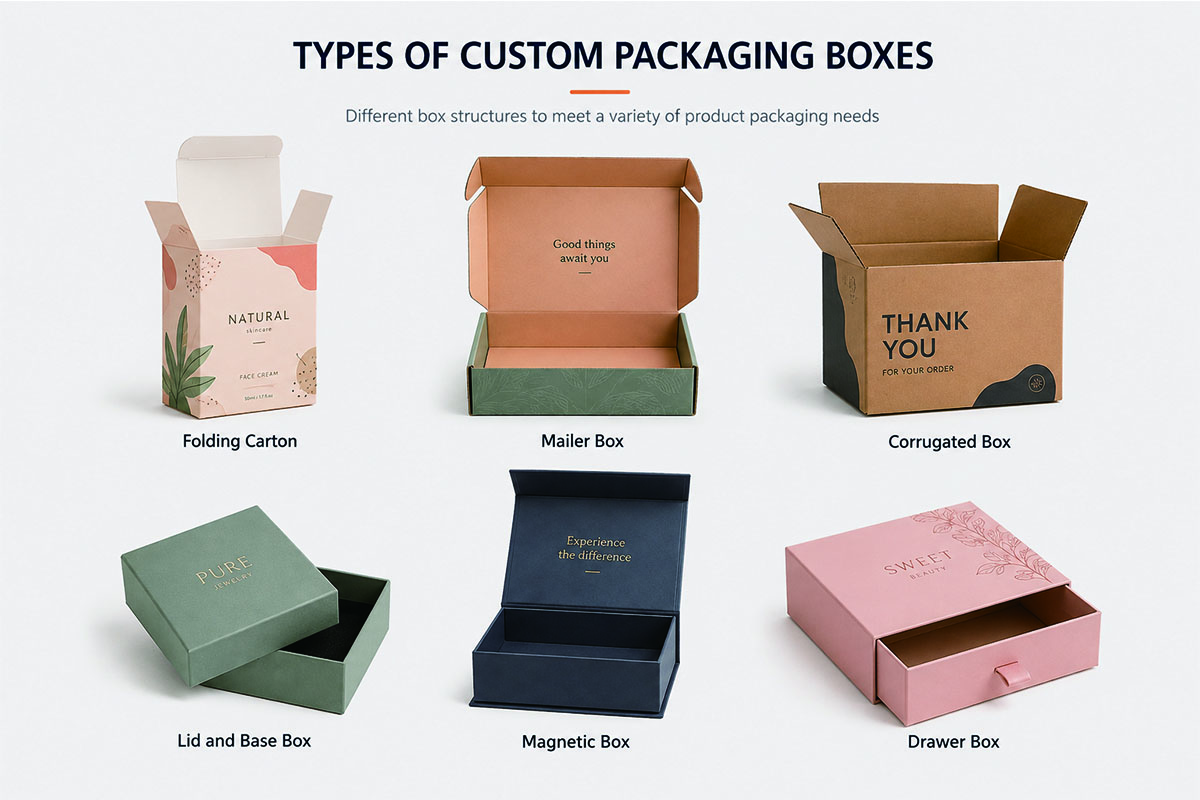
Folding cartons are among the most cost-efficient custom paper packaging options and are widely used for retail products, cosmetics, apparel accessories, and consumer goods.
Their relatively simple structure allows them to be produced efficiently at larger quantities. The final cost depends on factors such as paperboard thickness, dimensions, printing coverage, coating, and additional finishing.
Folding cartons are often a practical choice when brands need printed retail packaging while maintaining efficient storage and transportation.
Custom mailer boxes are commonly used by e-commerce brands, subscription services, apparel companies, and direct-to-consumer businesses.
Because mailer boxes are designed for shipping and presentation, their cost depends on the corrugated material, flute type, dimensions, printing requirements, and structural design.
A custom mailer box can also combine product protection with branded unboxing experiences.
Corrugated boxes are primarily used when product protection and shipping performance are important.
The cost depends on the corrugated board structure, flute type, board strength, box dimensions, printing, and order quantity.
For heavier products or products requiring additional protection during transportation, the appropriate corrugated specification should be selected based on actual product and shipping requirements.
Rigid boxes are commonly used for premium and luxury packaging, including jewelry, gifts, cosmetics, electronics, and high-end retail products.
Unlike folding cartons, rigid boxes use thicker board and generally require more manufacturing and assembly processes. This contributes to their higher unit cost.
Common rigid box options include lid-and-base boxes, book-style boxes, and other premium rigid structures.
Magnetic boxes add a magnetic closure mechanism to a rigid packaging structure. They are often used for premium gifts, cosmetics, apparel accessories, electronics, and luxury products.
The price can be affected by the number and type of magnets, board thickness, wrapping paper, finishing, inserts, and manual assembly.
Magnetic packaging can also create a more distinctive opening experience, making it suitable for brands that place a strong emphasis on presentation and unboxing.
Drawer boxes feature a sliding inner tray and outer sleeve. They are frequently used for cosmetics, jewelry, gifts, apparel accessories, and other premium products.
The production cost depends on the dimensions, board material, printing, wrapping paper, finishing, ribbon or pull tab options, and inserts.
Several factors determine the final price of a custom packaging project. Understanding these factors can help buyers make better decisions before placing an order.
Order quantity is one of the most important factors affecting the unit price of custom packaging.
Custom packaging may involve setup costs such as tooling, sampling, printing preparation, and machine setup. When these costs are distributed across a larger number of units, the average cost per box can decrease.
For example, a 1,000-piece order may have a higher unit price than a 10,000-piece order with the same specifications.
However, ordering a larger quantity only makes sense when the packaging can be used within a reasonable period and storage requirements are manageable.
Different box structures require different materials, equipment, production steps, and assembly processes.
A folding carton generally requires fewer production steps than a rigid magnetic box. A magnetic box may require rigid board construction, paper wrapping, magnetic components, manual assembly, and additional finishing.
Therefore, the box structure should be selected based on the product, protection requirements, brand positioning, and intended customer experience.
The size of a packaging box directly affects material consumption.
Larger boxes generally require more paperboard or corrugated material and may also require more storage and shipping space.
Accurate dimensions are therefore important when requesting a quotation.
For most custom packaging projects, buyers should provide:
Length × Width × Height
along with the product dimensions when possible.
Different paper and board materials have different costs and performance characteristics.
Common materials for custom paper packaging include:
Kraft Paper
Art Paper
Greyboard
Corrugated Paper
Specialty Paper
The appropriate material depends on the product weight, required protection, printing requirements, appearance, and packaging structure.
Printing requirements can also influence packaging costs.
Common options include:
CMYK Offset Printing
Pantone Color Matching
Digital Printing
Interior Printing
The number of printing areas, color requirements, artwork complexity, and printing method can affect the final cost.
Additional finishing processes can increase production costs while providing a more distinctive appearance.
Common options include:
Matte Lamination
Gloss Lamination
Soft-Touch Lamination
Foil Stamping
Embossing
Debossing
Spot UV
Textured Paper
For premium packaging, brands can combine multiple finishing techniques. However, each additional process should be evaluated based on its visual and functional value.
Custom inserts can improve product presentation and protection but will add material and assembly requirements.
Common options include:
Cardboard Inserts
Paper Inserts
Die-Cut Inserts
Product Compartments
Ribbons
Handles
Magnetic Closures
The complexity of the insert and whether it requires manual assembly can affect the overall packaging cost.
Order quantity has a direct influence on average unit cost because certain packaging expenses are fixed or semi-fixed.
| Order Quantity | General Unit-Cost Trend | Typical Situation |
|---|---|---|
| 500 pcs | Higher | Small-volume production |
| 1,000 pcs | Moderate | Common starting quantity |
| 3,000 pcs | Lower | Improved production efficiency |
| 5,000 pcs | Lower | Better cost efficiency |
| 10,000+ pcs | More competitive | Fixed costs distributed across larger volume |
These figures are intended to illustrate the general relationship between order quantity and unit cost rather than provide fixed prices.
A larger order does not necessarily mean a lower total expenditure. Buyers should consider expected sales volume, storage capacity, inventory turnover, and packaging usage before choosing an order quantity.
Kraft paper is often selected for mailer boxes, e-commerce packaging, and brands seeking a natural packaging appearance.
Art paper provides a smooth printing surface and is widely used for retail and gift packaging.
This combination is commonly used for rigid boxes. Greyboard provides structural strength, while the wrapped art paper provides the printed outer appearance.
Corrugated paper is commonly used for shipping cartons and mailer boxes because it provides a balance between protection, weight, and shipping efficiency.
Specialty papers can provide unique colors, textures, and tactile effects for premium packaging. Depending on the specification, they may increase material costs.
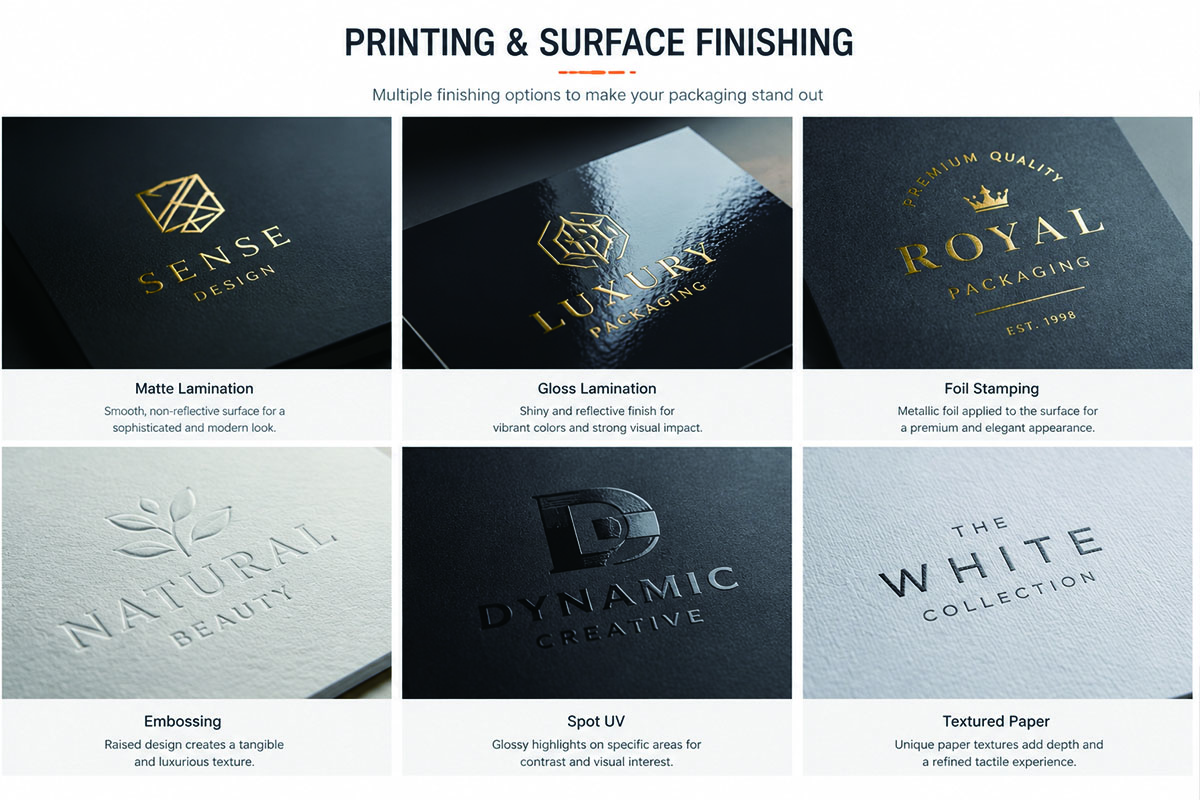
Printing and finishing are important parts of custom packaging design because they influence both appearance and production requirements.
| Printing / Finishing | Main Benefit | General Cost Impact |
|---|---|---|
| CMYK Offset Printing | Full-color graphics | Low–Medium |
| Pantone Matching | Consistent brand colors | Medium |
| Matte Lamination | Smooth, premium surface | Low–Medium |
| Gloss Lamination | Glossy appearance | Low–Medium |
| Foil Stamping | Metallic premium effect | Medium–High |
| Embossing | Raised tactile effect | Medium |
| Spot UV | Highlights selected areas | Medium |
| Textured Paper | Distinctive tactile appearance | Medium–High |
For example, a basic printed folding carton may require only printing and lamination, while a luxury rigid box may combine specialty paper, foil stamping, embossing, and custom inserts.
Choosing finishing based on actual design requirements can help brands achieve the desired appearance without adding unnecessary production complexity.
When calculating a packaging budget, the quoted unit price is not always the complete project cost.
Buyers should also consider the following:
Certain packaging structures require custom cutting dies or other tooling before mass production.
Physical samples may be produced to verify the structure, dimensions, materials, artwork, and finishing before production.
Custom inserts add additional material and may require extra assembly.
Some rigid and specialty packaging requires manual assembly, which can affect production costs.
International packaging projects should also consider shipping costs. Freight can vary according to:
Shipping volume
Product weight
Packaging dimensions
Shipping method
Destination
For some packaging structures, flat-pack or collapsible designs can improve shipping efficiency compared with fully assembled rigid packaging.
When comparing packaging suppliers, buyers should avoid evaluating projects based only on the unit price.
For example, one quotation may include certain costs within the unit price, while another supplier may list tooling, sampling, inserts, assembly, or shipping separately.
A better comparison should consider:
Product Specification + Unit Price + Additional Costs + Shipping = Total Packaging Cost
This provides a more realistic basis for comparing different packaging solutions.
Cost efficiency does not necessarily mean choosing the cheapest material or simplest box.
Instead, brands can improve packaging cost efficiency through better planning and specification decisions.
Select a packaging structure that matches the product's protection and presentation requirements.
Avoid unnecessarily large packaging that increases material consumption and shipping volume.
The most expensive material is not always the best choice. Material selection should consider product weight, protection, appearance, and intended use.
Foil stamping, embossing, UV, and specialty papers can enhance packaging, but they should be applied where they create meaningful visual value.
Higher quantities can improve unit-cost efficiency, but inventory requirements should also be considered.
For e-commerce and international orders, packaging dimensions and shipping configuration can influence the overall delivered cost.
A: Custom packaging can range from less than $1 per unit for simple folding cartons to several dollars for premium rigid, magnetic, and specialty boxes. The final price depends on the packaging specifications and order quantity.
A: Larger quantities can generally reduce the average unit cost because setup and tooling costs are distributed across more units. However, the appropriate quantity should also take storage and inventory requirements into account.
A: Simple folding cartons are generally among the more cost-efficient custom paper packaging options. However, the best packaging structure depends on the product and its protection and presentation requirements.
A: A custom rigid box may typically cost around $1.50–$6.00 per unit under bulk-order conditions. Larger sizes, premium materials, complex finishing, inserts, and special structures can increase the final price.
A: A custom magnetic box may typically range from $2.50–$8.00 per unit, depending on dimensions, board thickness, wrapping paper, magnetic closures, printing, finishing, inserts, and order quantity.
A: The most useful information includes the box structure, dimensions, material, printing, finishing, inserts, order quantity, and shipping destination.
The cost of custom packaging in 2026 depends on much more than the type of box. Box structure, dimensions, material, printing, finishing, order quantity, inserts, and logistics can all influence the final price.
For brands purchasing packaging in bulk, the best approach is to evaluate the complete packaging solution rather than focusing only on the lowest unit price. Choosing the appropriate structure and materials can help achieve the right balance between product protection, visual presentation, functionality, and cost efficiency.
Share your box type, dimensions, quantity, and design requirements to discuss a packaging solution tailored to your project.


